History of the Smith Tower   (back)

When a New York tycoon named Lyman Cornelius Smith returned from Seattle in 1909 with plans for a 14-story office building to be constructed in that boondocks city, his son, Burns Lyman Smith, was waiting with loftier plans.

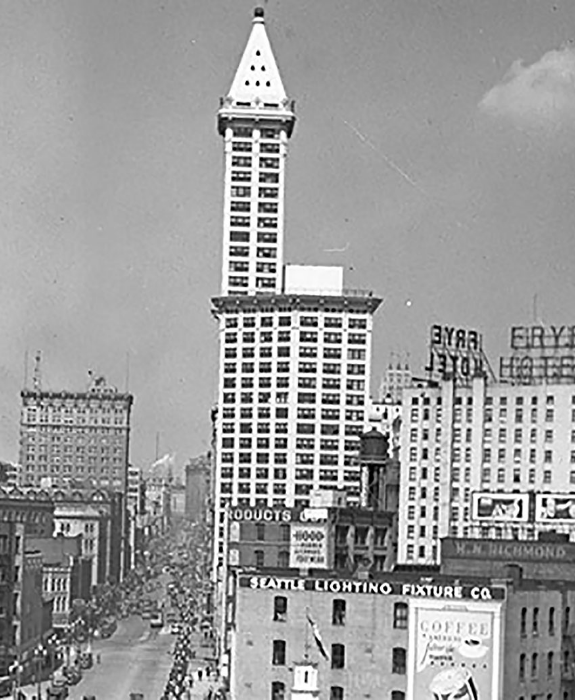
The result was construction of the Smith Tower, one of the world’s first skyscrapers, hailed in an agog Seattle and elsewhere as the tallest office building in the world outside New York City.

To an unsophisticated nation just being introduced to such 20th Century wonders as aspirin, crossword puzzles, brassieres, and neon signs, the newly minted skyscraper was another favorite of the Sunday supplements. The 522-foot L.C. Smith Building immediately joined their ranks, pictured in full page spreads which compared its height with the Great Pyramid of Giza (at 476 feet, the equivalent of 37 stories); St. Peter’s (435); the Cathedral of Cologne (512); the Washington Monument (555); the Woolworth Building (792), and the 984- foot Eiffel Tower.

The publicity was just what young Smith had predicted. Living in Manhattan, he had watched the building of the world’s first skyscrapers and quickly saw the publicity bonanza they were creating for F.W. Woolworth, the Singer Sewing Machine Co. and Metropolitan Life. Make the L.C. Smith Building the world’s highest outside of New York, he said, and the firm would have a cachet that would help elevate sales of Smith’s new product, the typewriter.

L.C. Smith, like another upstate New York manufacturing firm, E. Remington & Sons, had made his name and fortune in the manufacture of small arms. Earlier, Remington had successfully channeled those skills into production of the first workable typewriter, Smith followed.

Now as he listened to his son’s presentation, he quickly saw its value. If you want to push office equipment, make your office building a world-beater, the son argued. The father agreed. Plans were shelved for the 14-story building, a figure Smith had arrived at after talks in Seattle with John Hoge, also fresh from the East Coast and planning his Second Avenue and Cherry Street office building.

Instead, the Syracuse, N.Y. architectural firm of Gaggin & Gaggin, manfully rising above the fact it had never designed a structure higher than a few floors, created plans for one of the world’s earliest skyscrapers. It was to have a 21-story tower rising from a main 21-story structure, topped by a pyramid shaped Gothic cap, a design influenced by the circa-1909 Metropolitan Life Building young Smith had admired.

While this was going on, canny L.C. Smith leaked his plans to Seattle’s city fathers, archly suggesting that to make them final he would need assurances that municipal governmental offices would forevermore be within four blocks of his projected tower. A dazzled City Council responded with a resolution to that effect. (In 1954, the City of Seattle, then considering plans for a new Public Safety Building, was offered the Smith Tower for $900,000 with the nearby Smith Tower Annex thrown in for an additional $90,000 to serve as a garage. The offer was rejected on the advice of the City Planning Commission.)

The L.C. Smith Building with its 540 offices, including 60 in its Gothic Tower, was built without injury or incident, even setting a record during final stages when E.E. Davis & Co., steel contractors, erected eight tower floors during a single rainy week.

Around the steel framework was wrapped a cladding of white ornamented terra cotta, a material dating back into antiquity and so resistant to the assaults of city grime that the Smith Tower got its first face washing (with detergent) in 1976.

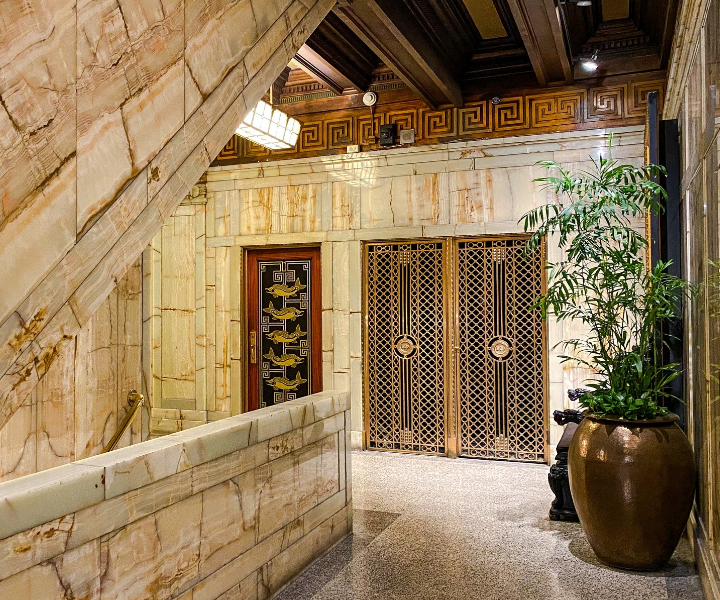
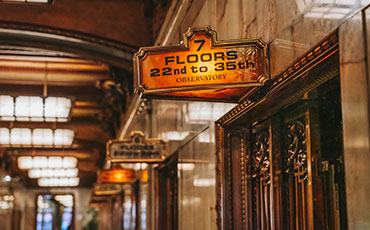
Little wood was used in construction of the Smith Tower, an innovation which didn’t endear a newcomer to a neighborhood of timber men. Window frames and sashes were fashioned of bronze. Doors were steel, hand finished to resemble highly grained mahogany. Mosaic tiles, Alaska marble and Mexican Onyx provided a mirrored setting for the highly polished brass used as a trim on the elevators and the telegraph and mail chutes.

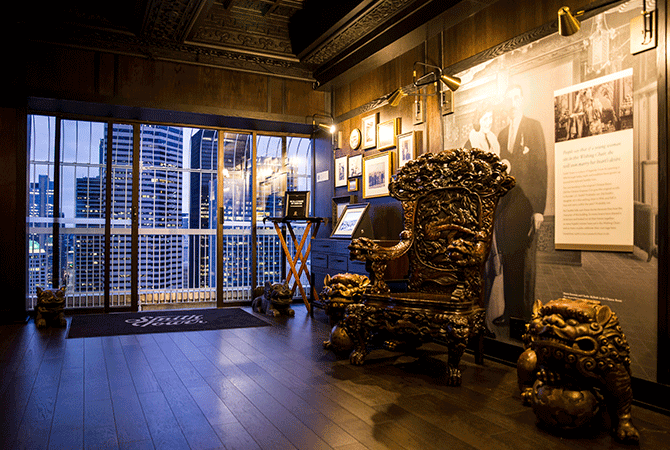
The crown jewel of the Smith Tower is the legendary 35th floor Chinese Room. The room’s name derives from the extensive carved wood and porcelain ceiling and the elaborately carved blackwood furniture that were gifts to Mr. Smith from the Empress of China. The observatory’s furnishings include the famed Wishing Chair. The chair, product of the skill of a Chinese carver and quite likely the skill of an early day virtuoso publicity man, incorporates a carved dragon and a phoenix, which when combined, portends marriage.

Hence the chair came with the sentimental- and sexist- legend that any wishful unmarried woman who sits in it would be married within a year. Some validity to the claim was noted, or at least implied, when Smith’s daughter was wed in the observatory a year following her visit to the building’s opening.

L.C. Smith did not live to see his $1 million tower completed. But his son was there opening day, July 3, 1914, when some 4,000 Seattle dignitaries and the common people rode to the 35th floor to gape at the city below from the observatory deck.

One who wasn’t among the invited guests was Vice Admiral Kuroi aboard the cruiser Asama, flagship of a Japanese Navy cruiser force then in Elliott Bay on a goodwill mission.

The next day, spurning invitations to Fourth of July auto races, balloon ascensions, parades and pageants, Admiral Kuroi telephoned C.G. Yadell, secretary of the Seattle Chamber of Commerce. To the flustered Yadell, the admiral said, or at least was quoted as saying: “I am burning with desire to see your beautiful city from the top of its highest building.” A few hours later, Yadell, Judge Thomas Burke (owner of a number of downtown buildings including the nearby Empire Building) and Burns Smith were on hand to escort the admiral to the Chinese observatory. There he murmured sympathetically as his hosts pointed out where Mount Rainier would be visible if it weren’t so unseasonably overcast.

To further smooth troubled waters, Smith presented Admiral Kuroi with Ticket No. 1 to the L.C. Smith building’s Chinese observatory. The admiral repaid the compliment by waving the pass aloft to reporters as his launch returned him to the Asama.

Adapted from The Seattle Times, Sunday, December 12, 1976

(back)


Home | Rates | Photos | Caterers Observation Deck | Smith Tower | Directions | FAQ

For more information contact us at:information@chineseroom.com

Copyright (c) 1999-2004, The Chinese Room at Smith Tower. All Rights Reserved.
Site maintained by HighTurn